

Key Takeaways
- Advancements in concrete technology are enhancing sustainability and efficiency in the construction industry.
- Innovations like 3D printing and self-healing concrete are revolutionizing building practices.
- Precast concrete offers design flexibility and reduces environmental impact.
Concrete has served as the essential backbone of the world’s infrastructure for centuries, providing the foundational support for bridges, roads, office towers, and other structures. As cities grow and construction demands increase, the need for stronger, more versatile, and more sustainable building materials has never been greater. New technological breakthroughs are transforming these time-honored materials, presenting solutions that accommodate both environmental challenges and modern engineering needs. Key innovations, including specialized techniques implemented by concrete contractors Macomb County MI, are paving the way for more innovative, longer-lasting infrastructure.
Traditional concrete faces challenges such as cracking, high energy consumption, and environmental vulnerability. To address these issues, innovations in concrete technology—such as 3D printing, self-healing concrete, and precast systems—are enhancing durability and reducing the ecological impact. These advancements are transforming infrastructure and the construction industry, providing safer and more sustainable solutions for communities and developers alike, as the capabilities of modern concrete continue to grow.
3D Printing: A Game-Changer in Construction
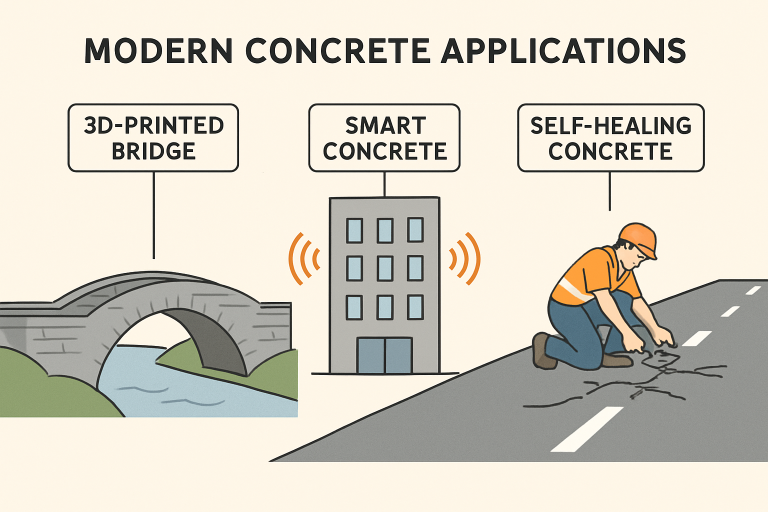
Among the most visually striking advancements is the use of concrete in 3D printing. This technology streamlines the fabrication process of complex architectural forms, enabling rapid prototyping of buildings and components. By using layer-by-layer additive manufacturing, it eliminates much of the waste typically found in conventional construction and enables unprecedented resource efficiency. In 2016, Spain witnessed a milestone with the inauguration of its first 3D-printed pedestrian bridge, underscoring the method’s practical potential and versatility.
Additionally, 3D printing enables customized solutions tailored to unique site requirements and design intents. Automated machinery can construct entire homes, bridges, or sculptures faster than traditional methods, significantly reducing labor hours and overall carbon emissions. This blend of flexibility and sustainability is reshaping the global construction landscape.
Self-Healing Concrete: Enhancing Durability
The advent of self-healing concrete is ushering in a new era for the industry, where infrastructure can maintain itself autonomously. By embedding healing agents such as bacteria or microcapsules within the mix, this concrete can react when water infiltrates cracks, automatically sealing the gaps and preventing further deterioration. This process drastically extends the useful lifespan of roads, tunnels, and bridges while reducing costly repairs and maintenance. Self-healing concrete is a boon in climates prone to harsh freeze-thaw cycles or intensive heavy traffic, where structures are at risk of cracking. The resilience offered by this technology means vital infrastructure can remain operational for far longer, ultimately lowering the economic and environmental costs of replacement. Discover more about technological developments in concrete at the BBC’s report on self-healing concrete trials.
Precast Concrete: Efficiency and Sustainability
Precast concrete is revolutionizing both the practical and environmental aspects of the construction process. Manufactured off-site in carefully controlled factory settings, precast components benefit from higher quality assurance, reducing defects and on-site errors. This method enables quicker installation, less disruption to neighborhoods, and a reduction in overall project timelines. Moreover, using molds and reusable forms facilitates innovative designs, empowering architects to push beyond the limitations of cast-in-place concrete. The process is inherently more sustainable, allowing for materials to be recycled and energy use to be optimized. Precast elements can incorporate a mix of natural and recycled aggregates, ultimately reducing waste and carbon emissions.
Smart Concrete: The Future of Infrastructure
Smart concrete represents the next frontier in infrastructure technology. By integrating sensors and digital systems, smart concrete can provide real-time data about the health and stability of a structure. These embedded sensors detect strain, stress, temperature changes, or movement, providing insights that enable engineers to perform preventive maintenance before minor issues escalate into major failures. Some varieties of smart concrete even harness vibrational energy from vehicle movement and convert it into electricity—an innovation that not only saves costs but also contributes to the growing movement towards energy-positive infrastructure. As smart concrete becomes more common, cities and contractors will have access to reliable data-driven maintenance strategies that help prevent disasters and extend the operational life of critical assets.
Challenges and Considerations
Despite profound benefits, the widespread adoption of innovative concrete technologies is not without hurdles. Initial investment costs for new materials or 3D printing technology can deter smaller firms, and a significant learning curve is associated with integrating new systems and digital monitoring into established practices. Additionally, local and national regulations must evolve to accommodate non-traditional concrete formulas, testing procedures, and installation methods, which can slow down implementation. Industry-wide education and sustained collaboration between policymakers, engineers, and builders are crucial for overcoming these challenges and ensuring smooth transitions towards next-generation infrastructure.
Conclusion
The integration of innovative concrete technologies is leading to the creation of infrastructure that is not only durable and efficient but also environmentally responsible. With advances such as 3D printing, self-healing, precast systems, and intelligent monitoring through smart concrete, the construction industry is set to meet the growing needs of modern society. Continued innovation and adaptation will ensure that future projects meet the challenge of building a sustainable and resilient world.