
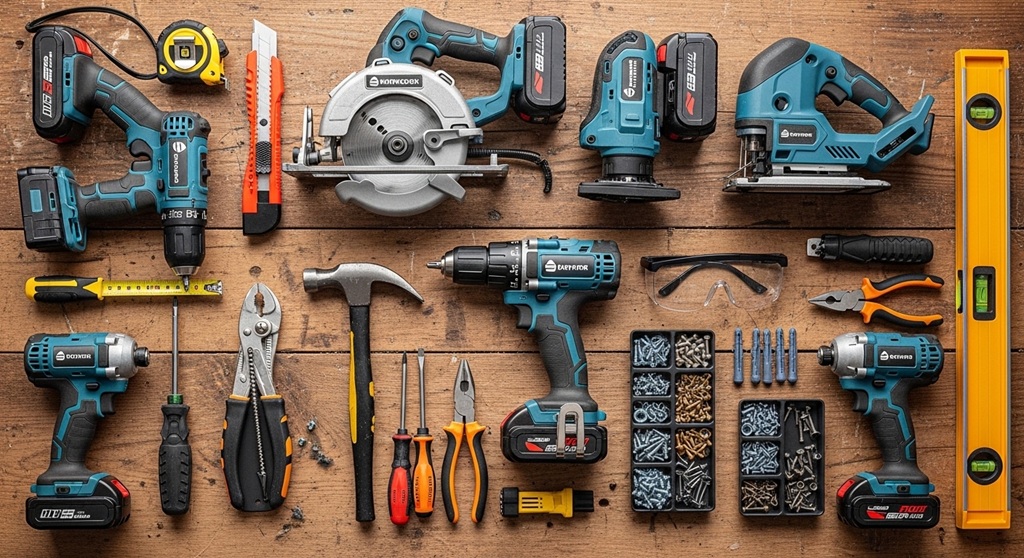
A DIY toolkit is a collection of essential tools used for home repairs, maintenance, and small construction tasks. A modern DIY tool list often includes cordless power tools because they provide mobility, efficiency, and ease of use.
Imagine a loose cabinet hinge, a squeaky door, or a shelf that needs mounting. Many homeowners delay small repairs because they lack the right tools. Over time, those small problems turn into larger and more expensive repairs.
This is the common problem many households face: relying on professionals for simple fixes that could easily be handled at home.
The solution is simple. Build a practical DIY toolkit with essential tools and cordless power tools that can handle most household repairs.
Modern cordless tools are powerful, compact, and easy to use. According to a 2024 global power tool market report by Grand View Research, the cordless power tool segment is growing at over 8% annually because homeowners increasingly prefer portable tools for DIY projects.
With the right home repair tools, you can fix, assemble, and maintain your home without waiting for professional help.
This guide explains how to build the perfect DIY toolkit using cordless power tools, what tools you need, and how to choose the right ones.
What Are the Essential Tools for a DIY Toolkit?
Quick Answer: A basic DIY toolkit should include a cordless drill, measuring tape, screwdrivers, hammer, adjustable wrench, utility knife, level, and pliers.
If you want to handle most home repair tasks, you need a combination of hand tools and cordless power tools. Each tool solves a specific problem.
Basic DIY Tool List
| Tool | Main Use | Why It Matters |
|---|---|---|
| Cordless Drill | Drilling holes and driving screws | Most versatile tool for DIY tasks |
| Hammer | Nailing and removing nails | Essential for construction and repair |
| Screwdriver Set | Tightening or loosening screws | Common for furniture and electronics |
| Adjustable Wrench | Tightening nuts and bolts | Useful for plumbing and appliances |
| Pliers | Gripping, bending, and cutting | Helpful for electrical work |
| Measuring Tape | Measuring dimensions | Prevents installation mistakes |
| Level | Checking straight alignment | Important for shelves and frames |
| Utility Knife | Cutting materials | Used in many DIY projects |
This list forms the backbone of a reliable DIY toolkit. With these essential tools, most minor household repairs become manageable.
Why Are Cordless Power Tools Important in a DIY Toolkit?

Quick Answer: Cordless power tools improve efficiency, portability, and speed compared to manual tools or corded tools.
Traditional tools require physical effort and time. Cordless tools reduce both.
The main advantage is mobility. You can work anywhere without worrying about power outlets or extension cords.
Another advantage is speed. Tasks like drilling, screw driving, and cutting become significantly faster.
Benefits of Cordless Power Tools
- No power cables
- Portable for indoor and outdoor work
- Quick setup and operation
- Improved precision and control
- Compatible battery systems
Many brands now design battery platforms where one battery works across multiple tools.
For example, a single lithium-ion battery can power drills, circular saws, impact drivers, and even leaf blowers.
This reduces cost when building a DIY toolkit.
Which Cordless Power Tools Should Beginners Buy First?
Quick Answer: Beginners should start with a cordless drill, impact driver, circular saw, and cordless sander.
These tools cover most home repair and DIY projects.
1. Cordless Drill
A cordless drill is the most important power tool for DIY work.
It drills holes, drives screws, and works on wood, plastic, and light metal.
Most homeowners use it for:
- Mounting shelves
- Installing cabinets
- Furniture assembly
- Wall anchors
A 12V or 18V drill is sufficient for most home projects.
2. Impact Driver
An impact driver is designed for driving long screws or bolts.
It produces rotational force that makes fastening easier.
This tool is useful for:
- Deck building
- Heavy furniture assembly
- Construction tasks
3. Cordless Circular Saw
A circular saw allows straight cutting of wood and boards.
DIY users commonly use it for:
- Shelf building
- DIY furniture
- Home renovation projects
4. Cordless Sander
A sander smooths wood surfaces before painting or finishing.
This tool improves the quality of DIY projects such as tables, cabinets, and decorative items.
How Do You Choose the Right Cordless Power Tools?
Quick Answer: Choose tools based on battery platform, voltage, ergonomics, durability, and brand ecosystem.
Buying random tools from different brands often leads to unnecessary battery costs.
A smarter strategy is to choose one battery platform and stick with it.
Important Factors to Consider
Battery System
Many brands offer shared battery systems. This allows one battery to power several tools.
Popular systems include 18V and 20V lithium-ion batteries.
Voltage
- 12V – light DIY tasks
- 18V / 20V – standard DIY and home repair
- 36V – heavy construction tools
Ergonomics
Tools should feel balanced and comfortable during use.
Lightweight tools reduce fatigue.
Durability
Look for tools with metal gear housing and brushless motors.
Brushless motors last longer and use less energy.
What Real Case Studies Show About DIY Toolkits?
Quick Answer: Studies show homeowners save significant repair costs by handling minor repairs themselves using basic tools.
A 2023 survey conducted by HomeAdvisor found that homeowners spend an average of $2,458 annually on home maintenance.
However, many repairs fall under simple DIY tasks.
Examples include:
- Installing shelves
- Fixing cabinet doors
- Repairing loose handles
- Replacing fixtures
According to the study, homeowners who perform minor repairs themselves reduce maintenance expenses by nearly 35%.
That means a DIY toolkit can pay for itself within a year.
For example:
| Repair Task | Professional Cost | DIY Cost |
|---|---|---|
| Install shelf | $80–$150 | $10–$20 |
| Fix cabinet hinge | $60–$120 | $5–$10 |
| Replace door handle | $70–$130 | $15–$25 |
These numbers explain why more homeowners are investing in cordless power tools.
How Should You Organize Your DIY Toolkit?
Quick Answer: Store tools in a toolbox, categorize them by function, and keep batteries and accessories organized.
A well-organized toolkit improves efficiency and saves time during projects.
Practical Organization Tips
- Use labeled compartments for small parts
- Keep drill bits and screwdriver bits together
- Store batteries in a dry place
- Separate hand tools and power tools
- Use wall storage for frequently used tools
Organization ensures you always know where your tools are.
What Safety Practices Should DIY Tool Users Follow?
Quick Answer: Always wear safety gear, read tool manuals, and inspect tools before use.
DIY work is safe when proper precautions are followed.
Basic DIY Safety Rules
- Wear safety glasses
- Use gloves when cutting materials
- Keep workspace clean
- Disconnect batteries when changing accessories
- Use the correct tool for the job
Safety improves confidence and prevents injuries.
Conclusion: Why Building a DIY Toolkit Is Worth It
Small home problems appear every week. A loose screw. A shelf that needs mounting. A cabinet hinge that keeps falling.
Without tools, these small problems become frustrating and expensive.
A well-planned DIY toolkit solves this problem.
With essential tools and cordless power tools, homeowners gain independence and control over home maintenance.
Tasks become faster. Repairs cost less. Projects become possible.
Building the perfect DIY toolkit does not require dozens of tools. Start with a few essentials, add cordless tools gradually, and expand as your projects grow.
Ready to upgrade your home repair skills?
Start building your DIY toolkit today and invest in cordless power tools that make every project easier, faster, and more efficient.
Frequently Asked Questions About DIY Toolkits
What tools should every DIY beginner own?
Every beginner should own a cordless drill, hammer, screwdriver set, pliers, measuring tape, adjustable wrench, and utility knife. These tools handle most household repairs.
Are cordless power tools better than corded tools?
Cordless power tools provide portability and convenience. Modern lithium-ion batteries offer strong performance, making them suitable for most DIY tasks.
How much does a basic DIY toolkit cost?
A beginner toolkit typically costs between $100 and $300 depending on the number of tools and brand quality.
What voltage cordless tools should homeowners buy?
Most homeowners should choose 18V or 20V cordless tools because they provide the best balance of power and portability.
How long do cordless tool batteries last?
Modern lithium-ion batteries usually last 3–5 years depending on usage and charging habits.
Can one battery power multiple cordless tools?
Yes. Many brands design battery platforms where one battery works across different tools such as drills, saws, and sanders.
Is building a DIY toolkit worth it?
Yes. A DIY toolkit helps homeowners save money on minor repairs and complete projects without hiring professionals.
Read More Also: How to Identify Durable Surf Fishing Reels That Last Years
Find out: How to Choose Zero Waste Kid Gift Ideas That Are Fun and Sustainable