
Key Takeaways
- Universal motors offer high power and low cost but wear out faster.
- Brushless motors last longer and run more efficiently than universal motors.
- Brush wear and sparking limit how long a universal motor survives.
- Switched reluctance motors offer another energy-saving alternative.
- Motor type affects noise, lifespan, and battery efficiency together.
Every vacuum relies on a motor to create suction. However, not all motors work the same way inside. Universal motors, brushless motors, and other specialized designs each offer different trade-offs. This guide explains how these motor types actually work. You will understand what drives your vacuum’s power, noise, and lifespan.
Why Motor Type Matters for Vacuum Performance
A vacuum’s motor spins a fan that pulls air, and dust, into the machine. Therefore, the motor sits at the center of nearly every performance factor you notice.
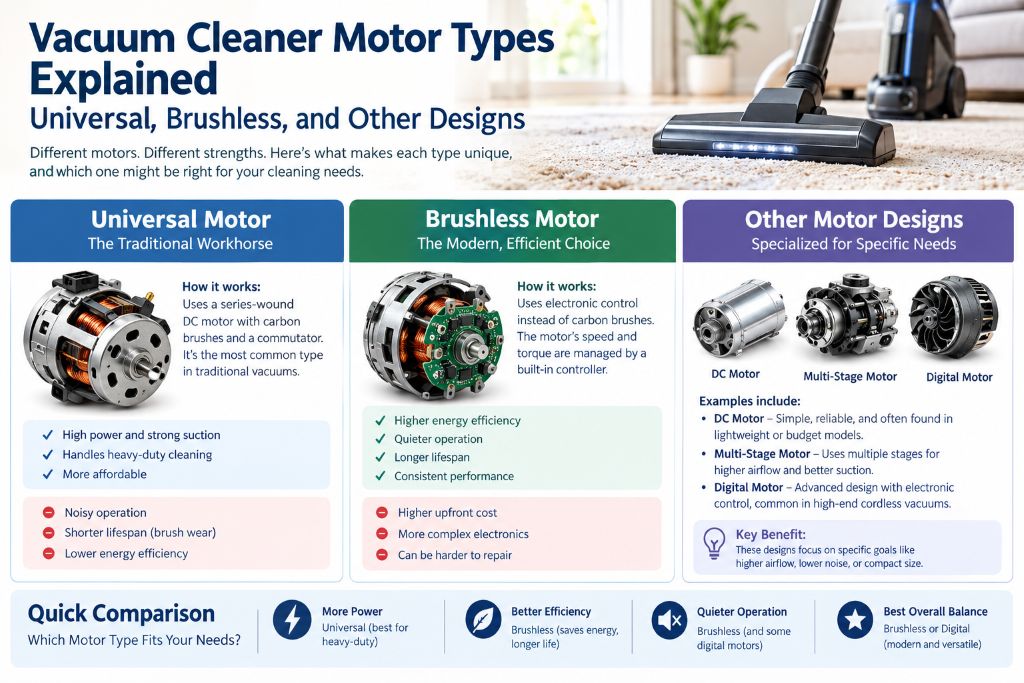
According to Texas Instruments, a universal motor has traditionally been the standard suction motor across most vacuum cleaners. This motor type dominated the industry for decades because it offered strong performance at a low manufacturing cost. However, this same source notes real limitations that pushed manufacturers to explore alternatives.
Motor choice affects far more than raw suction power. It also shapes how long your vacuum lasts, how loud it runs, and how efficiently it uses battery power. Therefore, understanding motor type helps explain differences between seemingly similar vacuum models.
A CITS electronics training resource summarizes this connection directly. It states that motor design can have a significant impact on a vacuum’s overall performance and efficiency. High airflow and high speed favor strong suction, while different designs favor torque for heavy-duty tasks instead.
Manufacturers have shifted strategies over recent years because of these trade-offs. Understanding the two main motor families, universal and brushless, explains why. Newer alternatives like switched reluctance motors add a third path worth knowing about too.
How Universal Motors Work
Universal motors have powered vacuums for generations. Understanding their basic design explains both their strengths and their well-known weaknesses.
Texas Instruments describes the universal motor as a series DC motor, specially built to run on both alternating current and direct current power. This flexibility made it a practical, adaptable choice for household appliances plugged into standard wall outlets.
Several genuine advantages explain its long popularity. The same source notes that universal motors offer high starting torque, operate at high speed, and remain relatively lightweight. Additionally, they are described as comparatively easy to control using simple electronics.
However, a critical mechanical weakness limits this motor type. Universal motors rely on physical carbon brushes that maintain contact with a spinning commutator. Texas Instruments explains that wear in these commutator brushes makes the motor poorly suited to continuous, heavy use.
A vacuum industry design report puts a specific number on this weakness. It states that a typical brush-type motor in a vacuum cleaner lasts only about 500 to 1,500 hours of total use. For comparison, this represents a modest lifespan given how often many households vacuum.
Noise represents another notable downside. Texas Instruments notes that the physical commutation process inside universal motors typically makes them quite noisy during operation. This happens because of the constant physical contact and small electrical sparking between the brushes and commutator.
How Brushless Motors Work
Brushless motors represent the modern alternative to this traditional design. As the name suggests, they eliminate the physical brushes entirely.
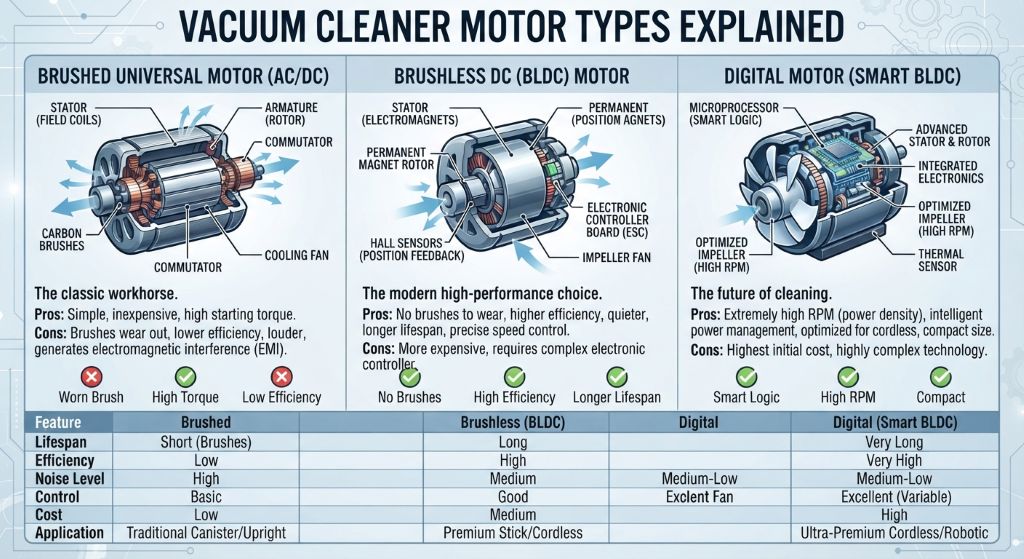
Texas Instruments describes the brushless DC motor’s construction as essentially a DC motor turned inside out. Permanent magnets sit on the rotating rotor, while the electrical windings stay fixed on the stationary stator. This reversed arrangement removes the need for brushes to transfer current to a spinning part.
Removing brushes solves several problems at once. Texas Instruments states that eliminating brushes removes the associated sparking, excess noise, and efficiency losses common in universal motor designs. Additionally, this construction allows for notably higher rotational speeds than brushed alternatives can typically reach.
A CITS training resource summarizes the practical benefits clearly. It states that brushless DC motors are more energy-efficient and have a longer lifespan than universal motors. This happens because electronic commutation replaces physical brush contact, directly reducing wear and mechanical friction.
Efficiency improvements matter significantly for battery-powered vacuums. Dreametech explains that brushless motors waste less energy as heat, meaning more available power converts directly into usable suction. Consequently, cordless vacuums with brushless motors typically achieve longer battery runtime per charge.
Control complexity is the main trade-off for this improved performance. Texas Instruments notes that commutation timing in brushless motors requires either position sensors or sensorless methods, such as monitoring back electromotive force signals. This need for additional electronics increases manufacturing complexity compared to simpler universal motor designs.
Comparing Lifespan and Reliability
Lifespan differences between these two motor types stem directly from their core mechanical designs. Physical wear plays the deciding role.
Universal motors face an unavoidable wear pattern from their brush-commutator contact. Every rotation involves physical friction between brushes and commutator segments. Over time, this friction gradually wears down the brush material until replacement or motor failure becomes necessary.
Brushless motors avoid this wear pattern entirely. Dreametech explains that eliminating friction between moving parts prevents the heat and gradual wear that would otherwise shorten a motor’s working lifespan. Without brushes to wear down, the motor’s primary failure point simply does not exist in the same way.
A related motor technology offers a useful comparison point for lifespan improvements. A vacuum industry design report describes switched-reluctance motor technology as another brushless alternative. Engineers using this approach reportedly extended vacuum motor lifespan to at least 5,000 hours, several times longer than typical brush-type motors.
This same switched-reluctance technology appears in academic research as well. A study published through ejournals.eu examined this motor type specifically as an energy-saving alternative for vacuum cleaner suction units. Researchers compared it directly against classic brush-commutator designs to assess real energy efficiency gains.
Maintenance needs follow this same lifespan pattern closely. Dreametech notes that brushless motors have fewer moving parts overall, which translates into less required maintenance and fewer components that could eventually break down. Therefore, brushless designs often mean less hassle over a vacuum’s working life.
Noise, Heat, and Energy Efficiency
Beyond lifespan, motor type shapes three everyday experience factors. Noise, heat generation, and energy use all connect back to the same underlying design differences.
Universal motors generate noise through their basic operating principle. The physical brush-commutator contact creates small electrical arcs during normal operation. Texas Instruments confirms that this commutation process is a primary reason universal motors run louder than alternative designs.
Brushless motors avoid this specific noise source since no physical brush contact occurs. Dreametech states plainly that this design allows the motor to run smoother and quieter overall. For households sensitive to vacuum noise, this represents a meaningful practical benefit.
Heat generation follows a similar pattern between the two designs. Brush friction in universal motors generates waste heat as a direct byproduct of normal operation. Dreametech notes that brushless designs prevent much of this heat buildup, since there is no physical friction between rotor and stator components to begin with.
Energy efficiency ties these factors together in a measurable way. The CITS training resource confirms that brushless motors produce less heat and require less energy to operate compared to universal motor designs. Since wasted heat represents lost energy, reducing heat generation directly improves overall efficiency.
This efficiency gain matters most for cordless, battery-powered vacuums. Dreametech explains that brushless motors are particularly well suited for cordless designs because they use less battery power for the same suction output. As a result, manufacturers increasingly favor brushless designs for handheld and robotic vacuum categories especially.
Which Motor Type Is Actually Better?
Neither motor design wins in every single category. Your priorities as a shopper should guide which trade-offs matter most.
Universal motors still offer clear advantages in specific situations.
- Lower upfront manufacturing and purchase cost
- High starting torque for immediate strong suction
- Simple, well-understood control electronics
- Long production history with proven reliability patterns
- Suitability for corded vacuums with unlimited power supply
Brushless motors offer different, often longer-term advantages instead.
- Significantly longer expected motor lifespan
- Quieter operation without brush-related noise
- Better energy efficiency, especially important for battery power
- Less heat generation during extended use
- Reduced ongoing maintenance needs over time
Corded vacuums historically leaned toward universal motors partly due to cost and unlimited power availability. However, this balance is shifting as brushless technology becomes more affordable to manufacture at scale. Many premium corded models now include brushless motors as a selling point.
Cordless and robotic vacuums show an even stronger shift toward brushless designs. Battery efficiency matters enormously for these categories, and Dreametech’s comparison confirms brushless motors directly extend usable runtime per charge. Therefore, expect brushless motors to dominate this segment increasingly over time.
Conclusion
Vacuum motor types shape far more than raw suction numbers alone. Universal motors offer proven, low-cost performance but wear down through physical brush contact over time. Brushless motors solve this wear problem while improving noise, heat, and energy efficiency, often at a higher initial cost. Switched reluctance motors offer yet another energy-saving alternative worth watching. If excessive motor noise becomes a concern, a noisy vacuum troubleshooting guide can help identify whether the sound comes from the motor, airflow, bearings, or another internal component.
Understanding these differences helps you interpret vacuum specifications more accurately. Check whether your next vacuum purchase uses a brushless motor, especially for cordless or robotic models. Compare motor type alongside suction ratings today, and choose a vacuum built to last as long as you need it to.
Frequently Asked Questions
What is the main difference between universal and brushless motors?
Universal motors use physical brushes that wear over time. Brushless motors use electronic commutation with no physical brush contact.
Which motor type lasts longer in a vacuum?
Brushless motors typically last much longer. They avoid the brush wear that limits universal motor lifespan.
Are brushless motors quieter than universal motors?
Yes, brushless motors run quieter overall. They avoid the sparking and friction noise universal motors produce.
Why do cordless vacuums often use brushless motors?
Brushless motors use less battery power for the same suction. This extends runtime per charge significantly.
Do brushless motors cost more than universal motors?
Generally yes, due to more complex electronic control systems. However, longer lifespan can offset this higher upfront cost.